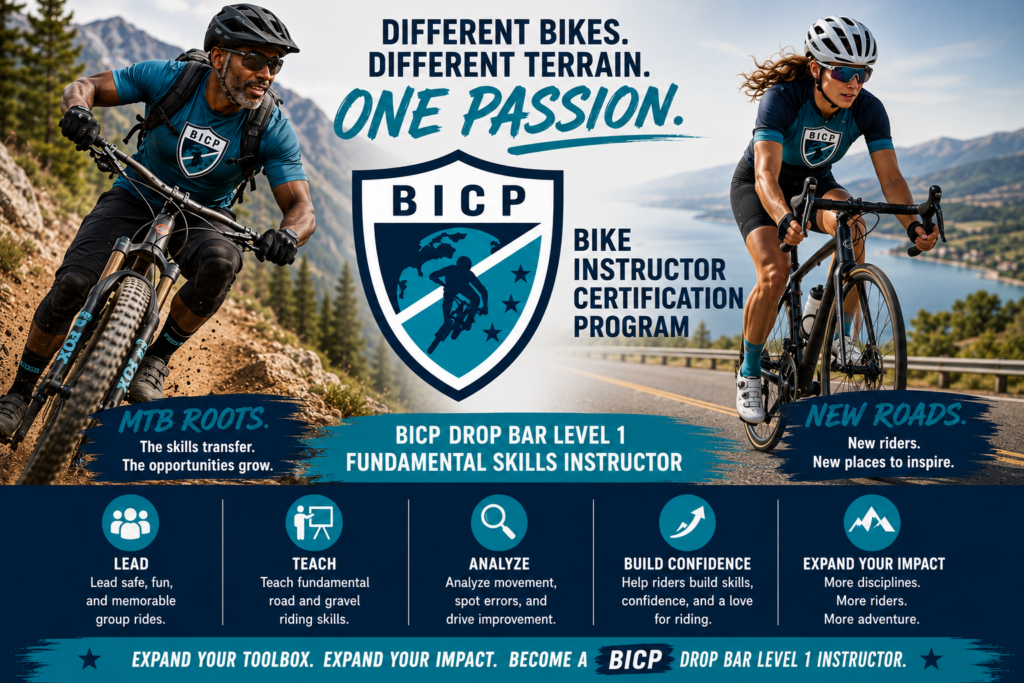
BICP Drop Bar Level 1 Fundamental Skills Instructor
Designed around BICP’s established teaching methodology and progression-based approach, this certification prepares instructors to teach riders in road and gravel cycling environments, with an emphasis on safety, skill development, communication, rider confidence, and effective group management.
The BICP Drop Bar Level 1 Fundamental Skills Instructor course provides comprehensive training for individuals who want to teach fundamental cycling skills to riders using drop bar bikes.
With the continued growth of road and gravel cycling, BICP developed the Drop Bar Level 1 certification to establish a consistent professional standard for leading riders, analyzing riding skills, and teaching fundamental drop bar cycling skills.
COURSE INFORMATION
Length: 3-day in-person certification course, plus required online coursework.
Cost: 700.00 + A $65 USD BICP DropBar Bike Level 1 membership will be added to your purchase.
Current BICP MTB Level 1 or MTB Level 2 members should contact BICP Administration regarding prorated pricing.
The Drop Bar Bike Ride Leader curriculum establishes the foundation in safety, leadership, communication, assessment, decision-making, and group management required before progressing to Level 1 skills instruction.
Ride Leader topics include:
- Ride Leader Tools.
- Pre-Ride Preparation.
- Managing Riders During the Ride.
- Decision-Making for a Safe Ride.
- Communication Guidelines.
- Ride Leader Best Practices.
The BICP Drop Bar Ride Leader Certification is included in the cost of the Level 1 course.
DROP BAR LEVEL 1 CURRICULUM
Building on the Ride Leader foundation, the Drop Bar Level 1 Fundamental Skills Instructor curriculum shifts from leading riders to teaching them.
The Level 1 curriculum is organized around four primary areas: Best Practices, Introduction to Instruction, Skills Analysis, and Fundamental Skills.
Chapter 1 — Best Practices
Participants learn how to prepare for and professionally manage a skills lesson, including:
These best practices establish a consistent framework for creating a safe, organized, and positive learning environment.
Chapter 2 — Introduction to Instruction
Participants are introduced to BICP’s teaching methodology and learn how to plan, deliver, evaluate, and adapt instruction for different riders.
Participants learn that effective instruction involves more than demonstrating a skill. An instructor must be able to communicate the skill, observe the rider, identify errors, provide appropriate corrections, select effective progressions, and measure rider success.
Chapter 3 — Skills Analysis
Participants develop a deeper understanding of how and why riding skills work through BICP’s skills-analysis framework.
This framework gives instructors the tools to analyze rider movement and understand the fundamental elements that contribute to successful skill performance.
Rather than simply teaching riders to copy a movement, instructors learn to recognize what the rider and bike are doing, why a skill is or is not working, and what can be changed to improve performance.
FUNDAMENTAL RIDING SKILLS
Participants learn to describe, demonstrate, analyze, progress through, and teach the fundamental riding skills included in the Drop Bar Level 1 curriculum.
Module 1 — Foundations & Bike Control
Module 2 — Bike Handling & Cornering
Module 3 — Climbing & Descending
These skills provide the foundation for developing greater balance, stability, braking control, bike handling, climbing, descending, and cornering ability on drop bar bikes.
FROM RIDE LEADER TO SKILLS INSTRUCTOR
The BICP Drop Bar certification pathway is designed as a progression.
Ride Leader → Learn to lead riders safely and effectively.
Level 1 Fundamental Skills Instructor → Learn to teach riders safely and effectively.
Ride Leader develops the participant’s foundation in ride preparation, rider assessment, communication, safety, decision-making, and group management.
Level 1 builds upon that foundation by developing the participant’s ability to:
- Understand the fundamental elements of riding skills.
- Clearly describe a skill and its purpose.
- Demonstrate skills correctly and consistently.
- Analyze rider and bike movement.
- Use appropriate skill progressions.
- Observe rider performance.
- Detect errors and identify their causes.
- Provide effective corrections and feedback.
- Adapt instruction to different riders and learning needs.
- Manage individuals and groups during skills instruction.
- Measure rider success.
- Create a safe, positive, and effective learning environment.
LEVEL 1 PREREQUISITES
Participants must meet the following prerequisites:
- BICP Drop Bar Ride Leader Certification. Included in the cost of the Level 1 course and mandatory for certification.
- Current First Aid & CPR certification.
- Three or more years of relevant cycling experience.
- Minimum age of 14 years old.
- Good communication skills.
- A strong desire to help others have more fun, build confidence, and progress safely.
- Fluency in English, including reading, comprehension, and speaking.
CERTIFICATION ASSESSMENT
Participants will be evaluated on their ability to understand, perform, demonstrate, analyze, and teach the BICP Level 1 curriculum.
Assessment areas include:
- Fundamental Elements.
- Skill Description.
- Demonstrations.
- Group Management.
- Error Detection & Corrections.
- Progressions.
- Communication.
- Leadership & Professional Conduct.
Participants must also complete the required online coursework and quizzes and successfully complete the required in-person teaching simulations and riding assessments.
BICP MINIMUM RIDE STANDARD
The BICP uses the Minimum Ride Standard when evaluating participants for certification.